
Anyone who has spent forty-five minutes standing in line at a bank branch in Karachi, or watched an OPD waiting area in Lahore turn into controlled chaos by 10 AM, understands the same frustration: there’s no way to know how long the wait actually is, or whether the system is even fair.
This is exactly the gap a proper queue management system in Pakistan is designed to close — and increasingly, banks and hospitals are the two sectors driving its adoption.
Why Banks and Hospitals Struggle the Most Without One
Banks deal with a mix of transaction types — cash deposits, account opening, loan inquiries, cheque clearance — each requiring different staff and different time. Without a structured system, customers queue in whichever line looks shortest, staff get overloaded unevenly, and branch managers have no real data on peak hours or bottlenecks.
Hospitals face an even harder version of the same problem. OPD patients, emergency cases, lab test collections, and pharmacy pickups all compete for the same physical space and staff attention. A manual token system (or worse, no system at all) means elderly patients, in particular, end up standing for extended periods with no clear sense of their position in line.
Both environments share the same root issue: queues without visibility create frustration, and frustration creates complaints, complaints create staff burnout, and eventually, it becomes a reputation problem for the branch or hospital.
What a Queue Management System in Pakistan Actually Solves
A dedicated queue management system in Pakistan — built for high-footfall environments like bank branches and hospital OPDs — typically addresses this through:
1. Digital token generation
Customers or patients pull a number (via kiosk, SMS, or app) instead of physically standing in a line, freeing them to sit, wait comfortably, or even step away briefly.
2. Service-specific queue routing
Rather than one single line, the system separates queues by service type — cash transactions vs. loan inquiries at a bank, or OPD vs. lab collection at a hospital — so staff only see relevant customers.
3. Real-time display and audio calling
A screen (and often an audio announcement) shows which token number is being served at which counter, removing ambiguity about whose turn is next.
4. Wait-time analytics for management
Branch and hospital administrators get actual data — average wait time, peak hours, staff performance per counter — something a manual system can never provide.
5. SMS or app-based remote queuing
More advanced systems let customers join a queue remotely and receive an SMS when their turn is approaching, reducing physical crowding entirely.
Why This Matters More in Pakistan Specifically
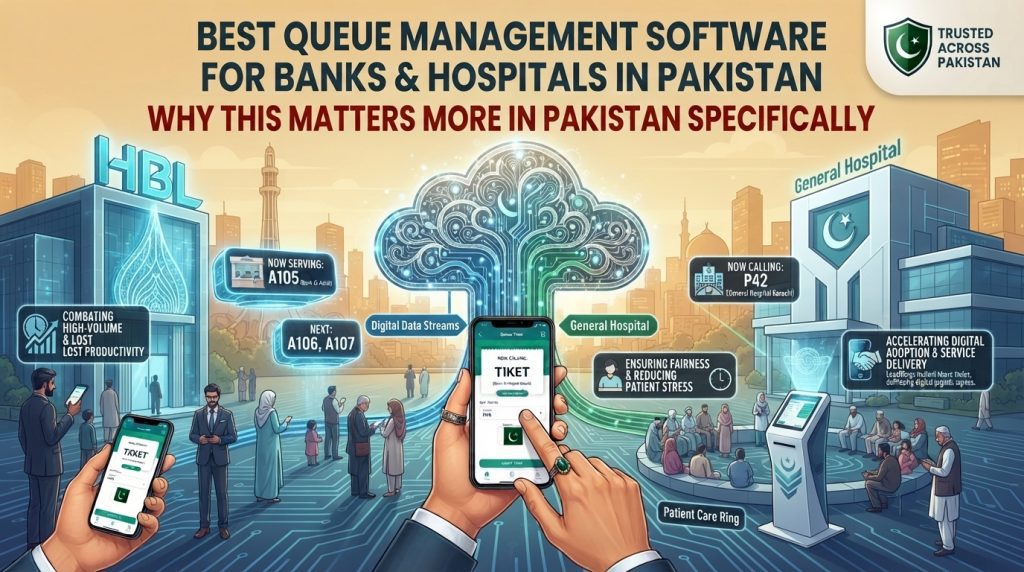
Pakistani banks and hospitals tend to serve a wider range of literacy levels, age groups, and urgency levels in the same physical space compared to many other markets. A system that works well here needs to be:
- Simple enough for elderly or less tech-familiar patients and customers to use without confusion
- Robust enough to handle high daily footfall (some urban bank branches and hospital OPDs see hundreds of visitors a day)
- Flexible enough to integrate with existing staff workflows rather than forcing a complete process overhaul
This is precisely why a queue management system in Pakistan needs to be evaluated differently than a generic international product — local footfall patterns, language needs, and infrastructure realities all matter.
What to Look for When Choosing One
If a bank branch or hospital administration in Pakistan is evaluating options, the priority list should include:
- Multi-counter, service-based queue routing
- Real-time display screens with audio calling
- SMS-based remote token/queue joining
- Analytics dashboard for wait times and staff performance
- Reliable performance during high-footfall hours without lag or downtime
Final Thoughts
The line at a bank counter or hospital OPD isn’t just an inconvenience — it’s a daily stress point for thousands of people across Pakistan, and a recurring operational headache for the staff managing it. A well-implemented queue management system in Pakistan doesn’t just make waiting more bearable; it gives management the visibility to actually fix the bottlenecks causing the wait in the first place.